
← Back to Beatles Singles Released in Canada
Vancouver's official Beatles Press Conference - Kellys
45.21.1.1 | Giveaway in Kellys shops on the West Coast
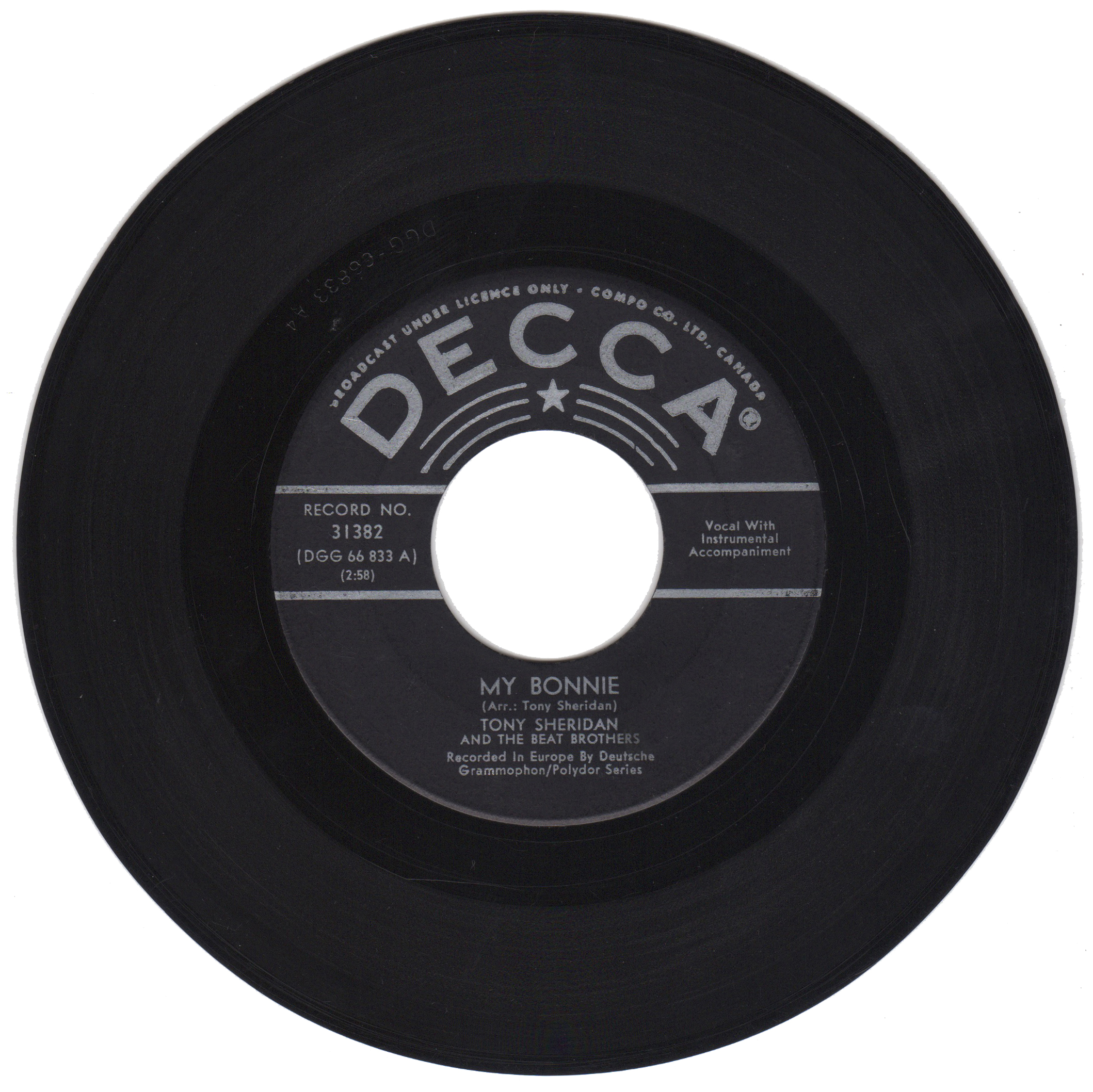
This is the very first record featuring the Beatles pressed in North America. Variation 45 1.1.1 is EXTREMELY scarce as only 10 surviving copies have been documented. The band's name does not appear on the label; the Beatles are credited as "The Beat Brothers", Tony Sheridan's backing group.
Variation 45 1.1.1 is the only pressing of this title and was released only in MONO. Many bootleg copies exist adorning a similar black and silver label, but authentic Canadian pressings can be recognized by its perimeter print identifying the COMPO, LACHINE pressing plant.
Availability
This one-time pressing on Decca was released on April 23rd, 1962. Only 200 copies were pressed, mostly for radio stations across the country, it received no airplay and sank without a trace. Most copies were either discarded or destroyed. It is EXTREMELY scarce as only 10-12 surviving copies have been documented. Considered by many as the Holy Grail of Canadian pressings.

General Information
The story of The Beatles' early days has been thoroughly documented, and today, the original artifacts are inseparable from The Beatles' narrative. One such artifact is their very first record, which has now been in existence for over fifty-five years. This is the tale of the first Beatles record issued in Canada—a record that, at the time of its release, did not sell at all and has since become a holy grail for Beatles collectors.
As related by Piers Hemmingsen, approximately 200 copies of Decca 31382 were pressed during the week of April 16, 1962, featuring black and silver paper labels. Once manufactured, each disc was placed in a brown paper stock Decca/Compo 45 RPM record sleeve stamped with the text "SAMPLE COPY NOT FOR SALE" in blue ink.
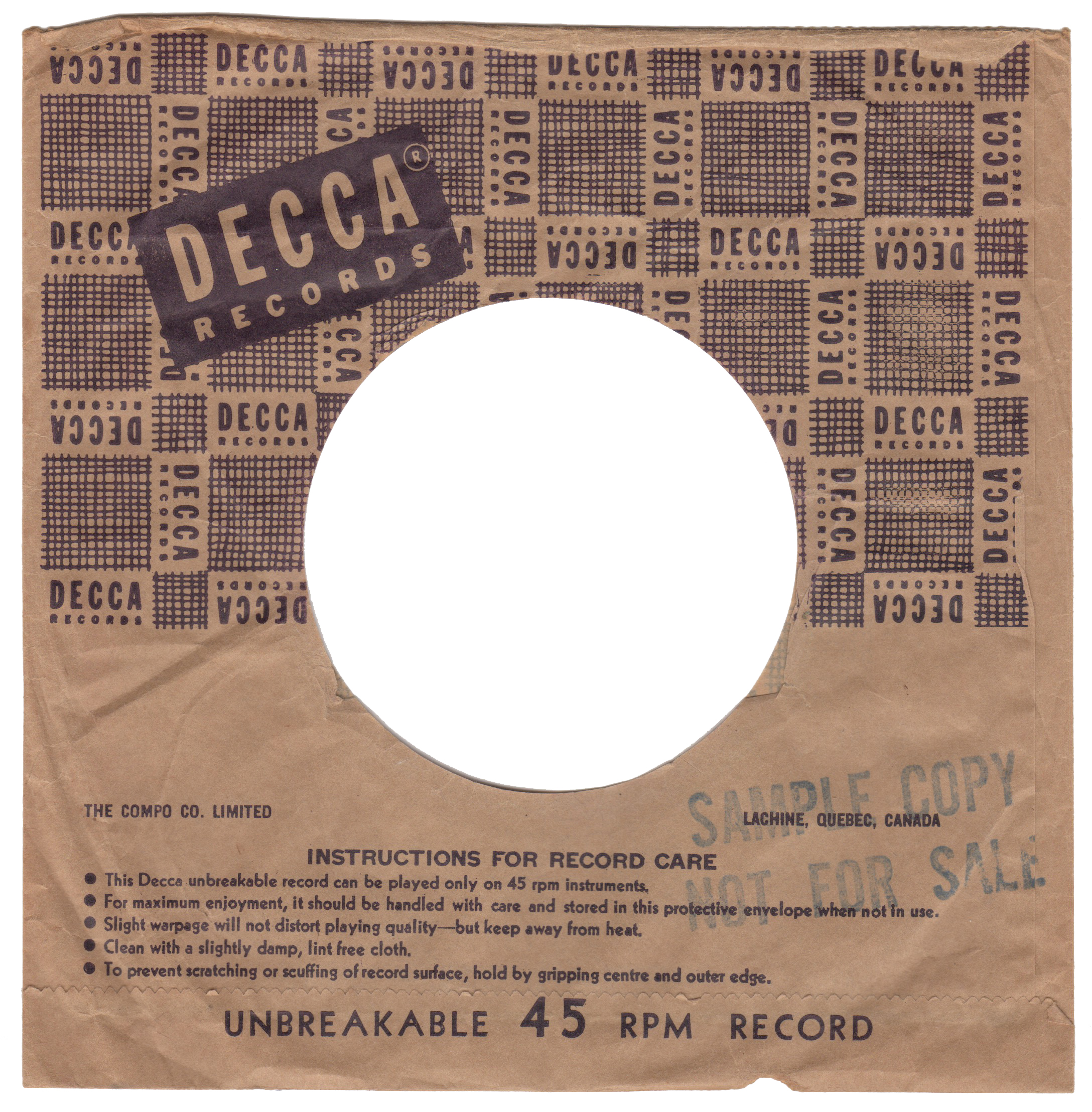
These 200 records were dispatched on Monday, April 23, 1962, for distribution to various radio stations across Canada as a new release.
For the source of this information and for more details on the release of My Bonnie on DECCA: P. Hemmingsen, The Beatles’ Canadian Discography part. 1 or on the Capitol6000.com website.
What makes this record so rare and collectable?
Today's collector's value of the original April 1962 disc is based on the fact that so few copies have survived to this day. There are only approximately 10 surviving copies that have been documented to date. Add to this the fact that the Beatles were still pretty much a locally popular band playing the backing track on a more prominent artist at the time, it is no surprise that this record virtually never received any airplay. Having this released in Canada seemed like a curious decision, but Decca being the distributor for European Polydor at the time, they issued the popular foreign catalogue in small batches, and Tony Sheridan made the cut. Furthermore, the Beatles name is not even featured on the label, it credits "The Beat Brothers" instead (see Pier's story of My Bonnie on capitol6000.com for more details on this nickname). Copies today sell for a premium, with recorded sales on average around 4000$-5000$ for a VG copy.
Pressing information
Original copies can be identified by the stamping marks in the run-out areas on either side of the vinyl disc. As stated above, the original 1962 Canadian Decca 45 was pressed from metal masters sent up from the U.S. Matrix numbers are machine-stamped into the vinyl (using the same matrix numbers that are printed on the Decca label). Machine-stamped matrix numbers on run-out area of A-side is “DGG-66833 A4” and machine-stamped matrix number on run-out area of the B-side is “DGG-24673 B4”.
An interesting detail about the matrix numbering of this 45 is that it was prepared from a coupling of the UK master with an ENGLISH introduction on the A-side (UK matrix), and with the original German master on the B-side (German matrix).

Even though masters were sent from the USA, the trail-off markings are different from the US pressings (theirs starting with 45, and ending with a 3 instead of a 4.).
Counterfeit copies
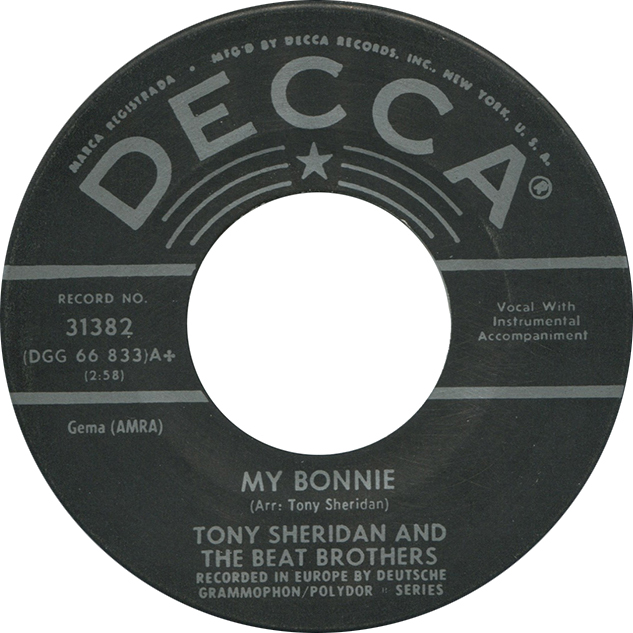
Like for most rare records, counterfeits copies of My Bonnie do exist, and were produced in the 1970s. Canadian copies not yet being well documented, they were originally believed to simply be illegal copies made from the US pink label promo (that still used the old style labels, unlike their regular stock copies that had moved to the Colorbar label). But Canada was still steadily using the old style black and silver DECCA labels until 1969, which resulted in US counterfeit copies being almost identical to the little known authentic Canadian pressings. The difference lies mostly on the USA perimeter legal print instead of the "Compo Lachine" text found on our authentic domestic pressings. On a side note, counterfeit labels have a more modern feel and feature solide silver bars on the B-side (all Canadian authentic copies have one of their silver bars broken on the B-side). Matrix numbers are also different and had written. All in all, the overall quality of these counterfeit is quite substandard, with many copies having a slightly wobbly sound.
Two categories of differences (a variation?)
Two sets of label printing differences can be found on this unique small batch of pressings. While these are not usually considered as an official variation according to our archive guidelines (natural printing differences within a same batch), being so rare, it was deemed important to note the differences here for collecting purposes because all copies seem to fall in either one of two categories.:
Category A, a clean version of the A-side label, with all the elements adequately printed, and
Category B: other copies (most of them) have some letters and lines in the same layout that are partially printed or broken, or heavily smudged in the same way.
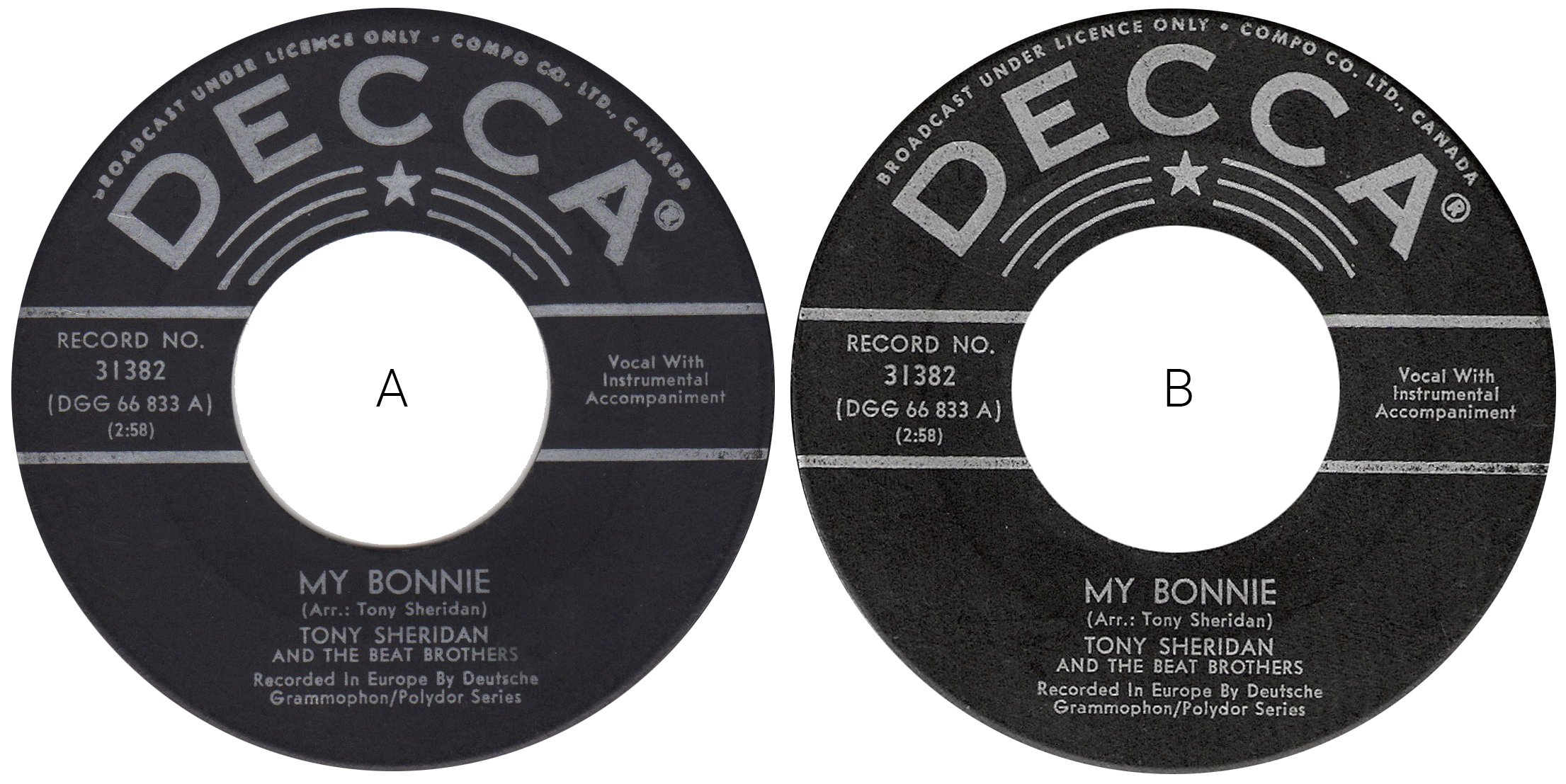
These variations are most likely the result of label printing discrepancies amongst the same batch of labels (or from two simultaneous printing presses that were calibrated slightly differently) and not from two distinct pressing runs. One clue hinting in that direction is that the broken horizontal silver bar on the B-side (a layout structural element that would have been corrected in a second run) is a defect found on both versions (and on no other pressings of the same period), meaning that the mistake in the printing master is found on all copies, while printing quality errors (rendering of the master) are found in two categories. Knowing the history of this record and its absence of traction on the market, a second run of pressings is extremely unlikely.
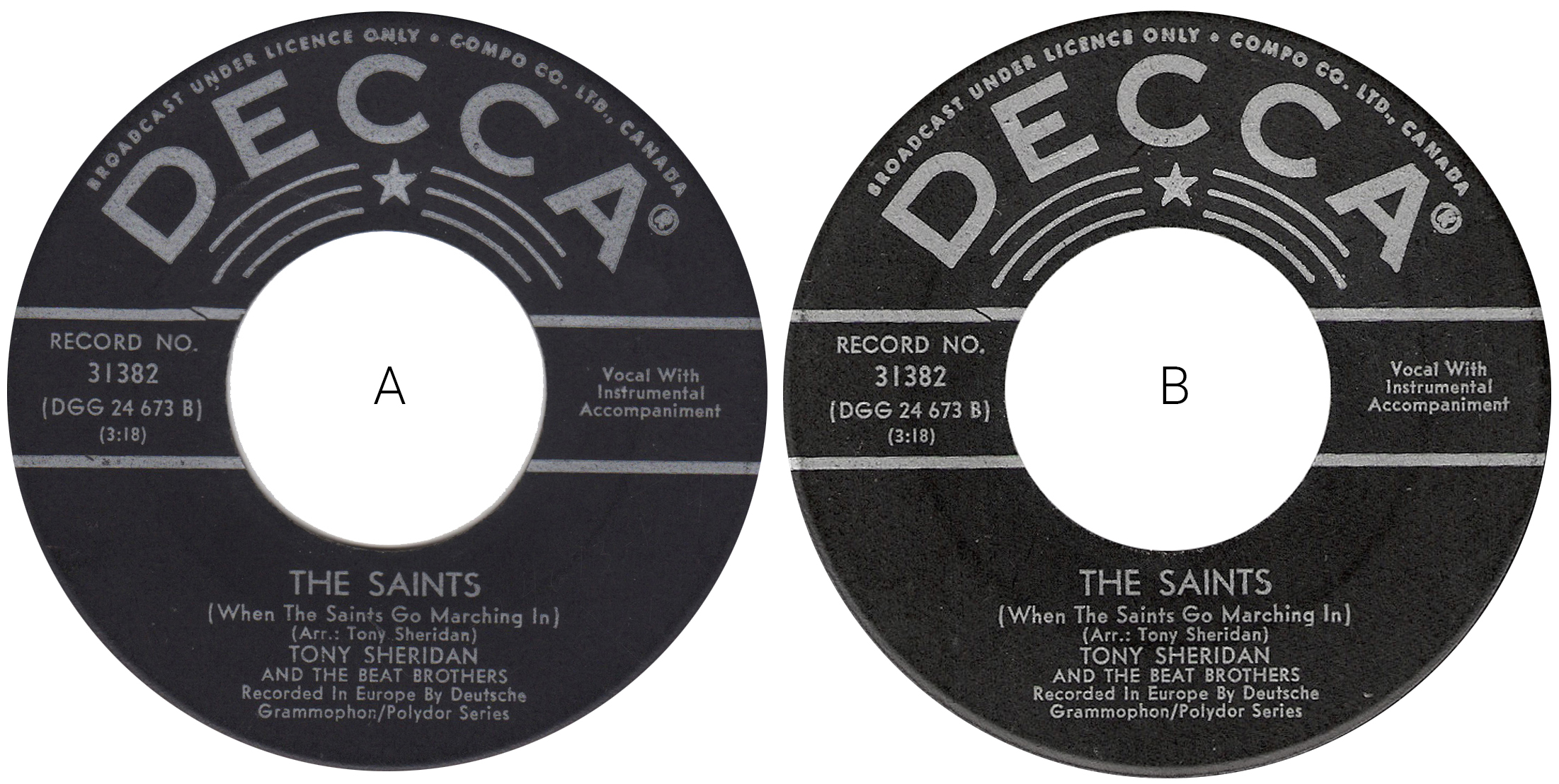
The differences detailed below can seem anecdotal, but are considered here to be interesting for two main reasons:
1. all documented copies fall into either of the two categories noted below, so there is a pattern and is not a range of random variations. And mostly
2. it demonstrates the range of (im)precision in label printing, even within a single batch of labels.
This is an important fact because in some instance, such fluctuating details (e.g. micro placement of printed text on the label) have been used by collectors as an official variation identifier (see for example 45.2.1.1).
This, according to the authors, although it can give interesting clues to variation identification, can not be considered a DEFINITE variation identifier -- True verified copies may indeed have a certain marker (e.g. the placement of a letter over a blank label), but conversely, no one can assume that ALL copies therefore carry the same markers because one copy officially did. In this sense, for example (if there had been more than one batches of the DECCA 45 pressed), printing smudges and text micro-placement could not be used to differentiate pressings without a doubt, these differences fluctuating across wide of a spectrum of imprecision across a single printing batch.
In the case of this particular 45, it is important to note that these differences do not make one of the variations any more desirable, or more valuable, they are simply interesting observational facts that highlight the possible variations found even across a very small batch of pressings.
Differences found on the DECCA My Bonnie labels
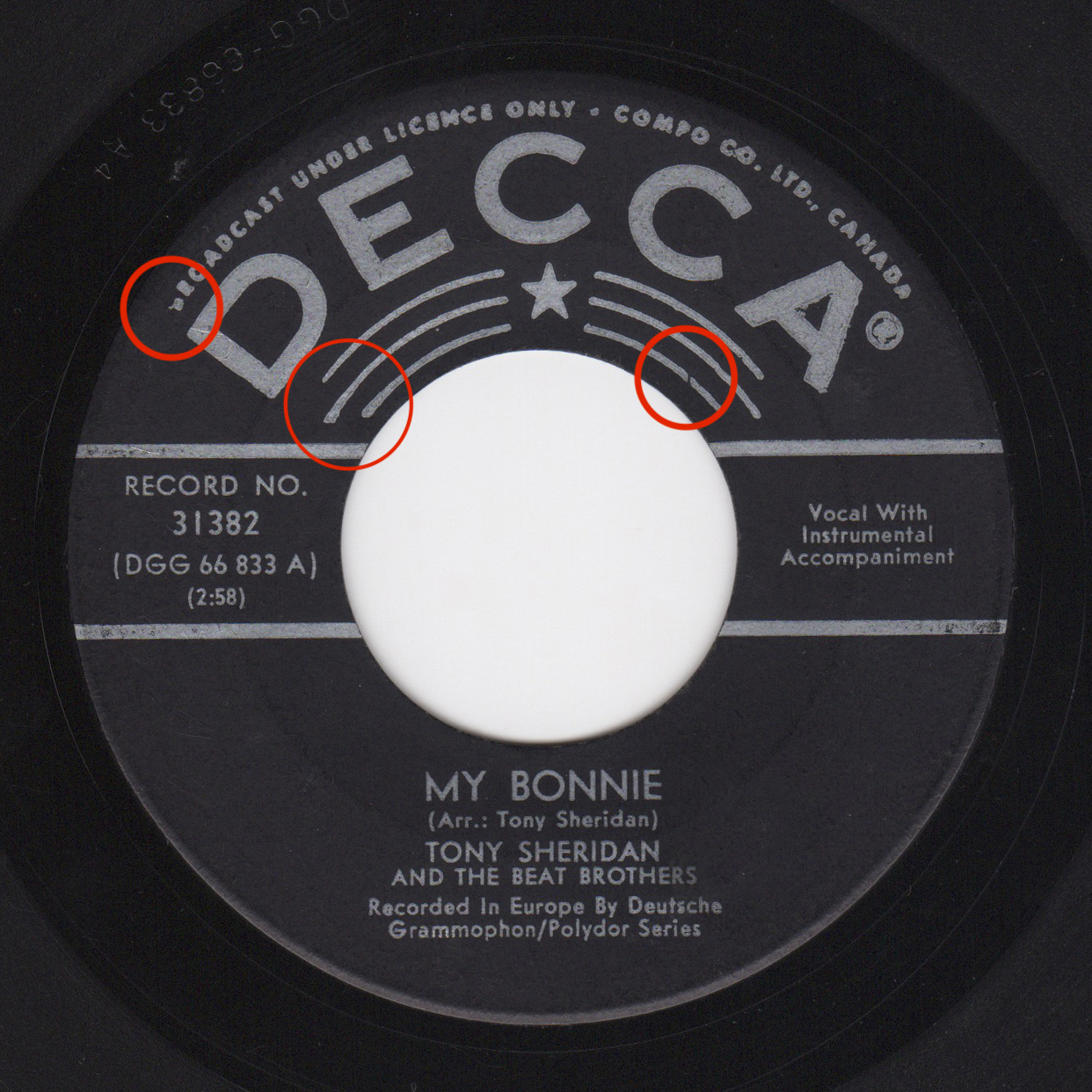
Category A - “Clean labels”
This variation includes:
A-side (properly printed printing master)
❖ “Full B” on the first letter of the word BROADCAST in the perimeter print
❖ Unbroken curved bottom line on the right side of the star
❖ Clean curved lines (left)

Category 2 - “Sloppy labels”
This variation includes:
A-side (printing process errors found on some copies)
❖ “Incomplete B” on the first letter of the word BROADCAST in the perimeter print
❖ BROKEN curved bottom line on the right side of the star
❖ Smudgy left curved lines
ON ALL VERSIONS
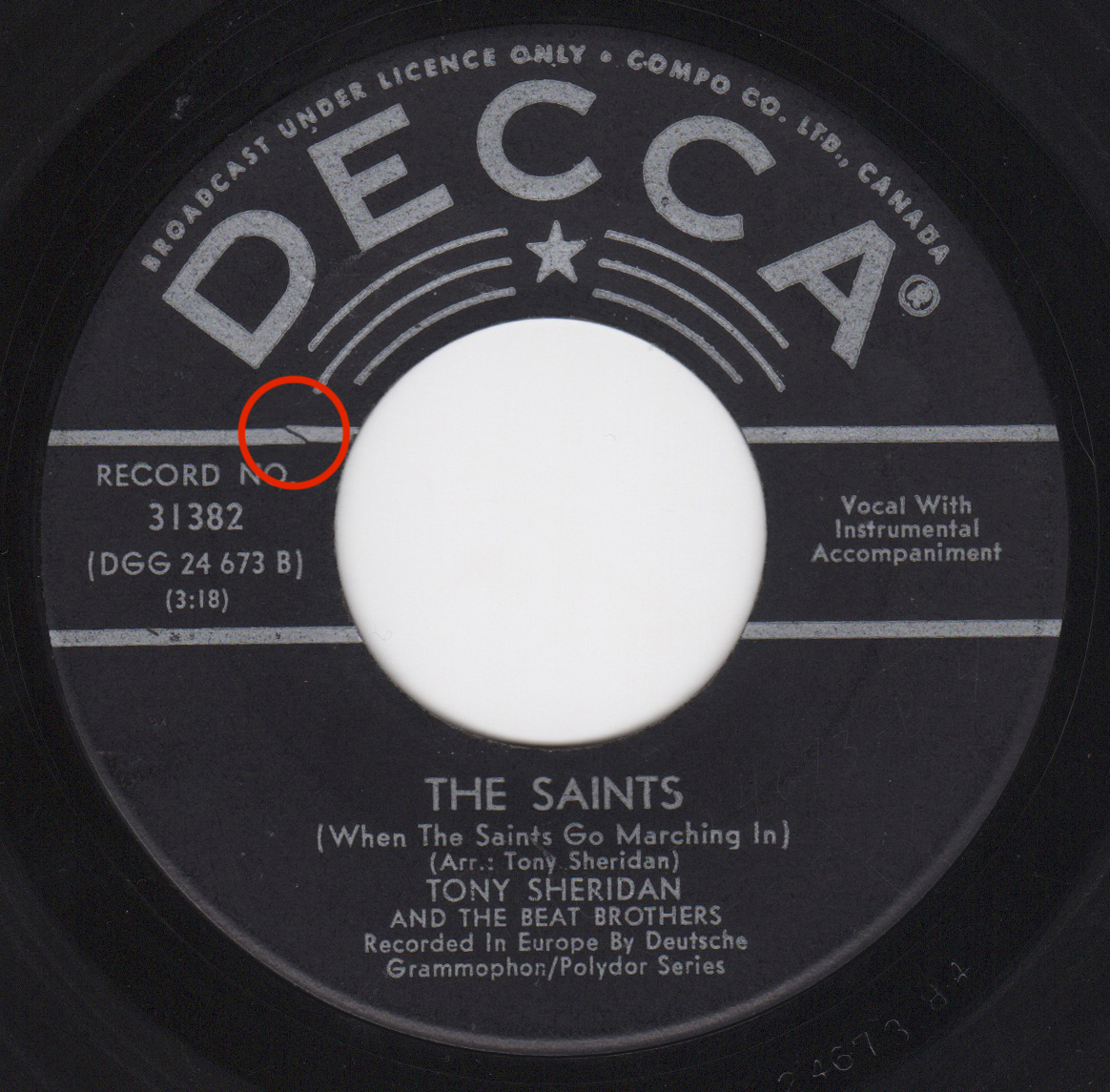
B-side (print master error, found on ALL copies)
❖ Broken horizontal bar on the left side of the label.
One last pressing detail
The label variations have been covered in detail in the previous sections, but one subtle detail is also deemed important enough to be covered in this archive. This pressing detail also helps authntifying an authentic Canadian copy of My Bonnie on the Decca label:
All copies that have been documented to date have faint hand-written markings across the label on each side, where what looks like matrix numbers are "carved" across the centre label. At a first glance, these look like pen marks that wer transfered to the paper label by a clumsy owner who would have used the disc as a sturdy surface to write on, but after examining many copies and confering with other collectors, every copy has the same markings, meaning that this was from the actual lacquer, and pressed into the records.
The engineer possibly wrote the matrix information across the centre of the blank lacquer before creating the master, figuring it would not show under the paper label. It seems though, it was deep enough to be visible through the label, showing on every copy pressed.

How many copies remain today?
Out of the 200 pressed, most were returned and recycled, while few if any, were sold to the public (most of them being sent to radio stations, receiving no airplay). So, being such an anecdotal release by an anecdotal band in 1961 who hadn't recorded any of their own material yet, how many copies remain today? It is estimated that 10-12 different copies have been confirmed in collections around the country. Copies do pop up from time to time in online auctions, but it has been verified to be the same few copies changing hands from time to time. A thorough comparative account of the remaining documented copies (with photos) have been compiled by the authors to be able to put forward a reliable number of surviving copies, but is not shared in this archive for privacy purposes.
This being said, it is possible that up to 15-20 copies still exist today, hidden in a home somewhere, as people do own unsuspected collections around the world. A good example is an account of "the find of a lifetime" by a fellow collector in the Montreal area (where the Compo pressing plant was settled) who bought a few boxes of records from the son of an ex Compo employee who had just passed away. Right there in one of the boxes lied a copy of the Decca My Bonnie 45. The employee probably just brought random records he pressed, not necessarily knowing what they were. Or yet, another collector friend who in the Vancouver area found one in the bargain bin of a garage sale.
So, copies are still out there today, but they are certainly in the low tens of copies. If you find one, do not hesitate to pick it up, and please let us know so we can keep our archive up to date.