
Beatles'65
LP.2228.7.2
Orange, 2nd Generation, ® Logo (Keel)
Early 1976 - late 1976
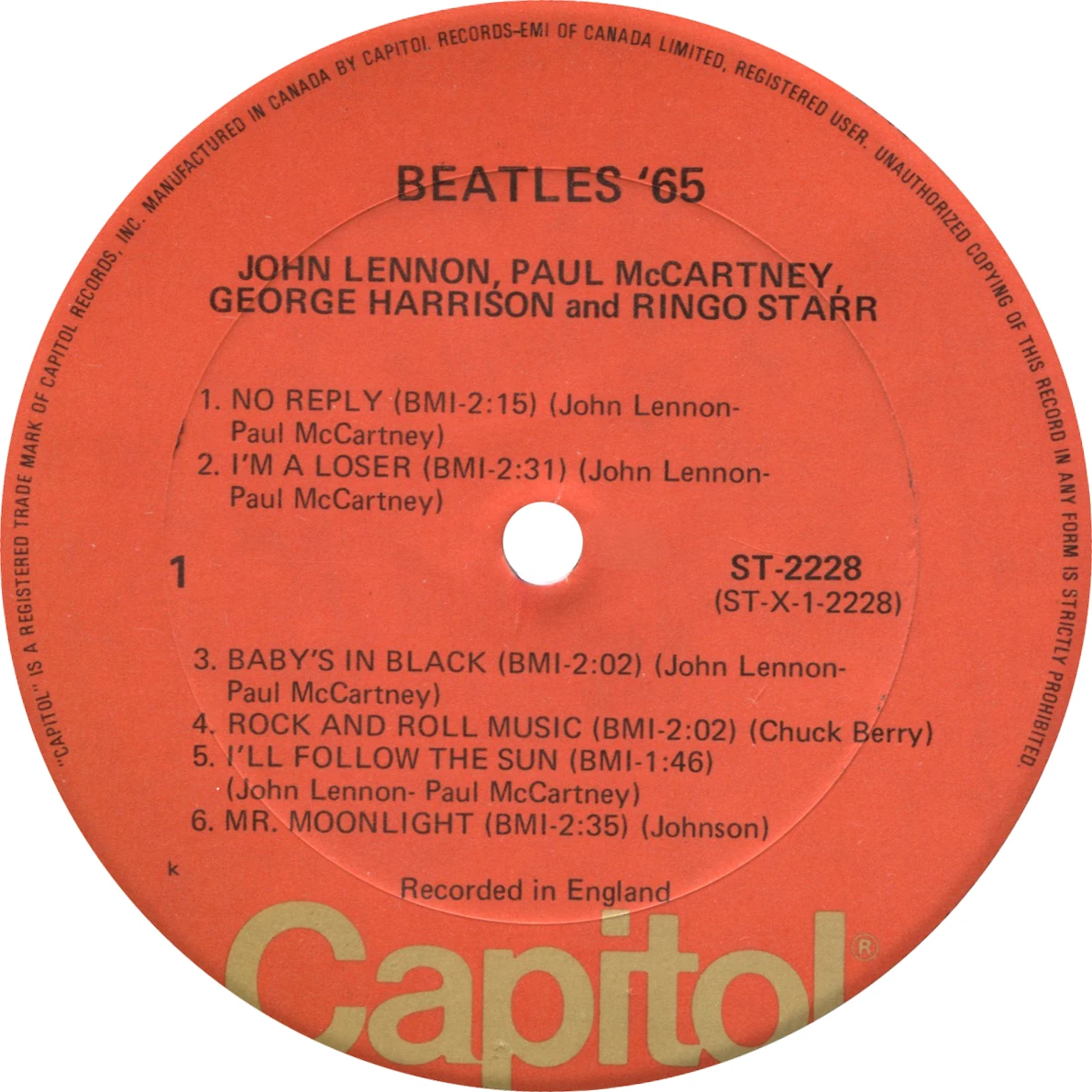
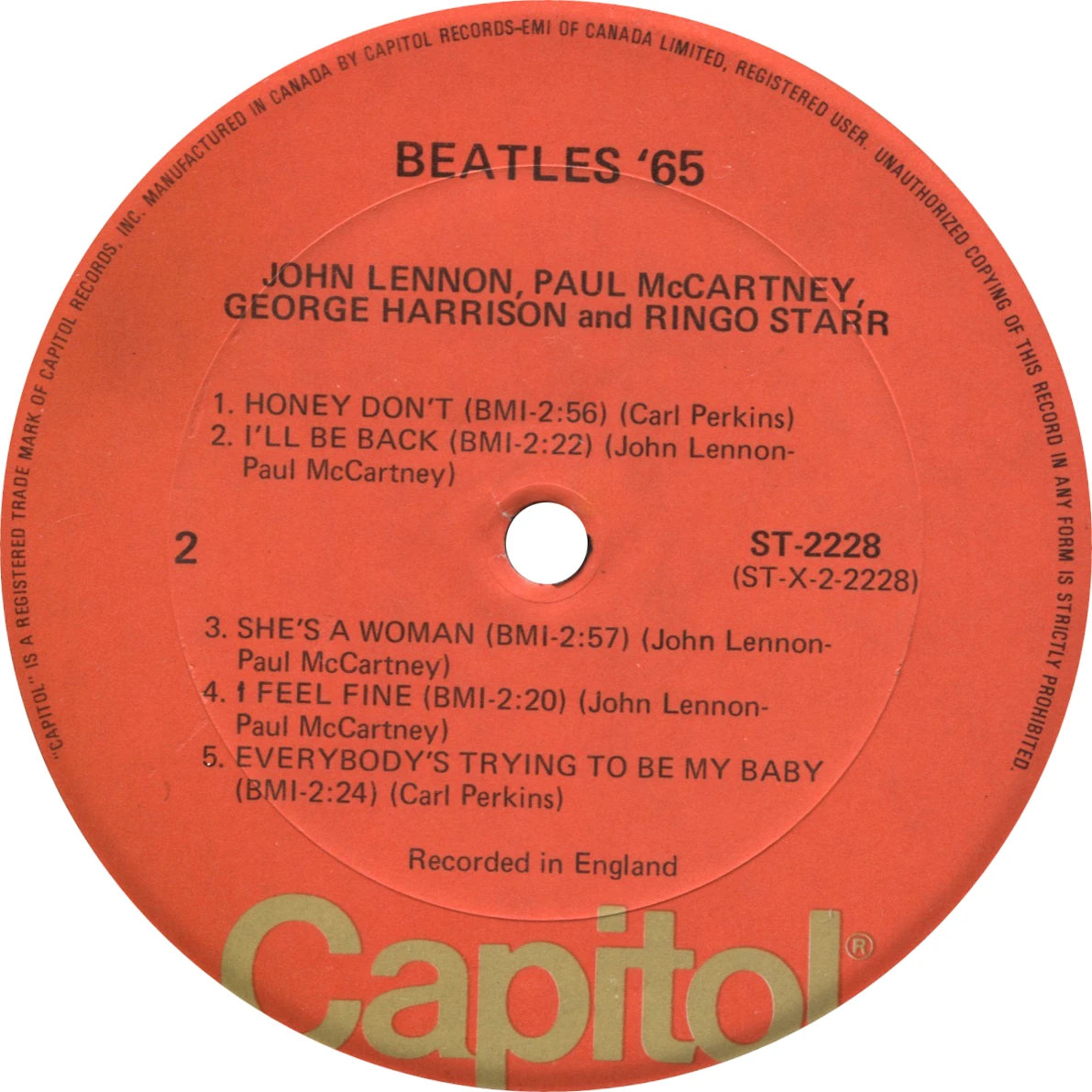
LP.2228.7.2 is still the second incarnation of the orange label, but this later variation is recognized by its black perimeter print on the label and its Registered (®) logo, which replaced the ™ logo of LP.2228.7.1 in early 1975. It was still pressed by Keel, but from a new master prepared by Capitol (the trail-off carries a stamped MASTERED BY CAPITOL marking).
Availability
This variation most likely dates from early 1976, and was available until late 1976, when Capitol started pressing its own albums at its new Mississauga pressing plant (see LP.2228.8.1). The MASTERED BY CAPITOL stamp in its trail-off places it shortly before the plant opened (see General Information below).
General Information
Second generation orange labels can be identified by the BLACK perimeter print around the label, much easier to read than the previous gold text, and by the new corporate name in that print, "Capitol Records-EMI of Canada Limited". Early copies carry a Trade Mark (™) logo next to the Capitol name; from early 1975 it was replaced by a Registered (®) logo. Once again, this label generation was unique to Canada at this point, since Capitol USA opted for the Apple label for their Capitol reissues until 1975.
Second generation orange label pressings with the ® logo, and third generation orange label pressings, are much more common than the earlier ™ logo pressings.
LP.2228.7.2 also gives a glimpse of Capitol's own plant before it opened. Its master was prepared by Capitol (stamped MASTERED BY CAPITOL) rather than by RCA, yet the discs were still pressed by Keel, and the Capitol target logo found on later pressings is absent. Capitol's Mississauga plant only started pressing albums in October 1976, but parts of the installations were most likely operational earlier that year (singles were already pressed there in early 1976), which would explain a Capitol master on a Keel pressing. This variation therefore most likely dates from early 1976.
Pressing Information
For the second generation orange labels, Capitol of Canada turned to Keel, a Toronto-area plant that pressed records for Capitol between 1969 and 1978 (Keel was already pressing for the budget labels Capitol distributed, such as Pickwick). Keel discs are recognized by their 70 mm thin pressing ring (similar in size to RCA's, but flat rather than deep-grooved, in the style of Columbia's ring) and by a generally lower quality of manufacture: the ring and the labels are not as cleanly pressed as on RCA or Capitol discs.
The hand-etched catalogue numbers look the same as on LP.2228.7.1, but these records were pressed from a new master prepared by Capitol: the trail-off also carries a stamped MASTERED BY CAPITOL marking, with no Capitol target logo (the logo appears later, on LP.2228.8.1):
Side 1: ST-1-2228
Side 2: ST-2-2228
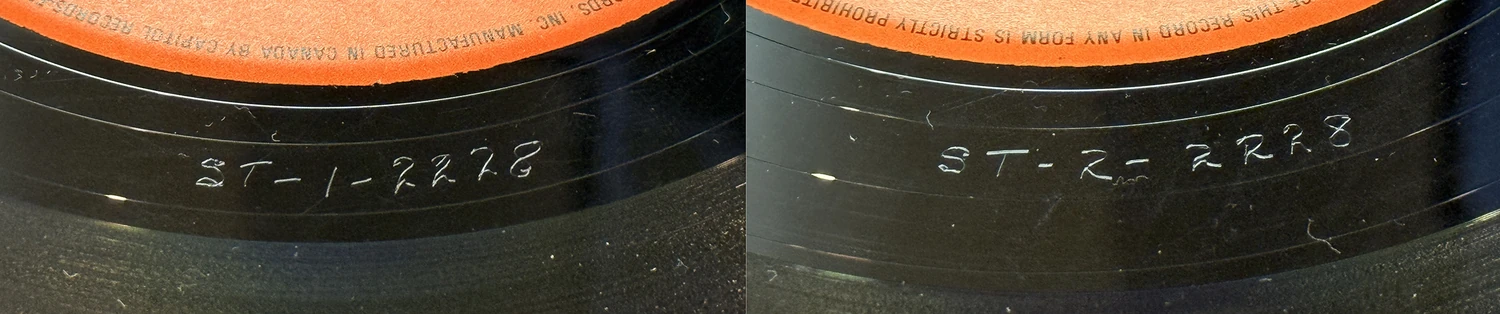
These pressings feature the 70 mm thin pressing ring typical of Keel, instead of RCA's 70 mm deep groove.
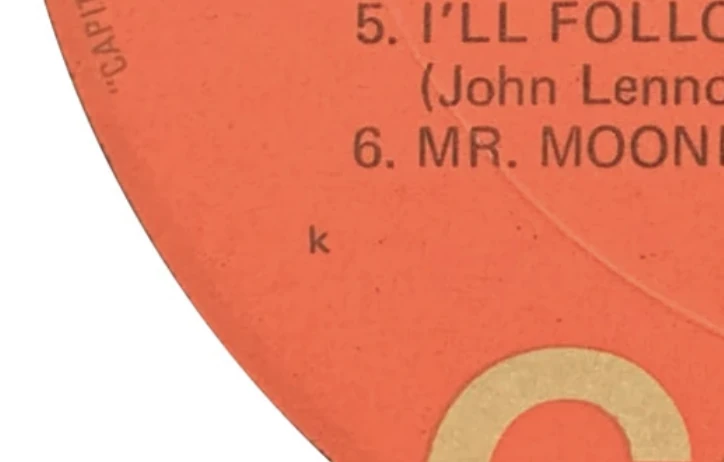
Keel pressings often carry another distinctive mark: a small "k" printed on the left side of the label, just above the Capitol logo. It is found on this variation as well as on LP.2228.7.1.
Cover
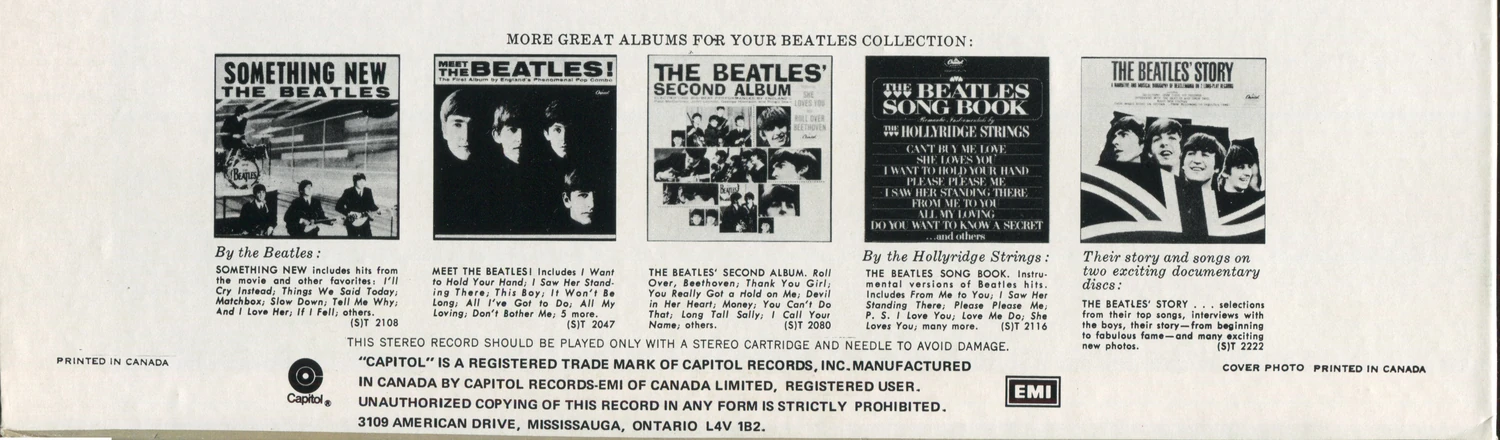
The cover of this variation is the same as the one found on LP.2228.7.1: the stereo banner and the "File Under" line have disappeared from the front cover, which now carries only the title, the song list and the Capitol logo. The back cover carries the Capitol-EMI legal line of the period at the bottom, with the EMI box and the 3109 American Drive, Mississauga address.
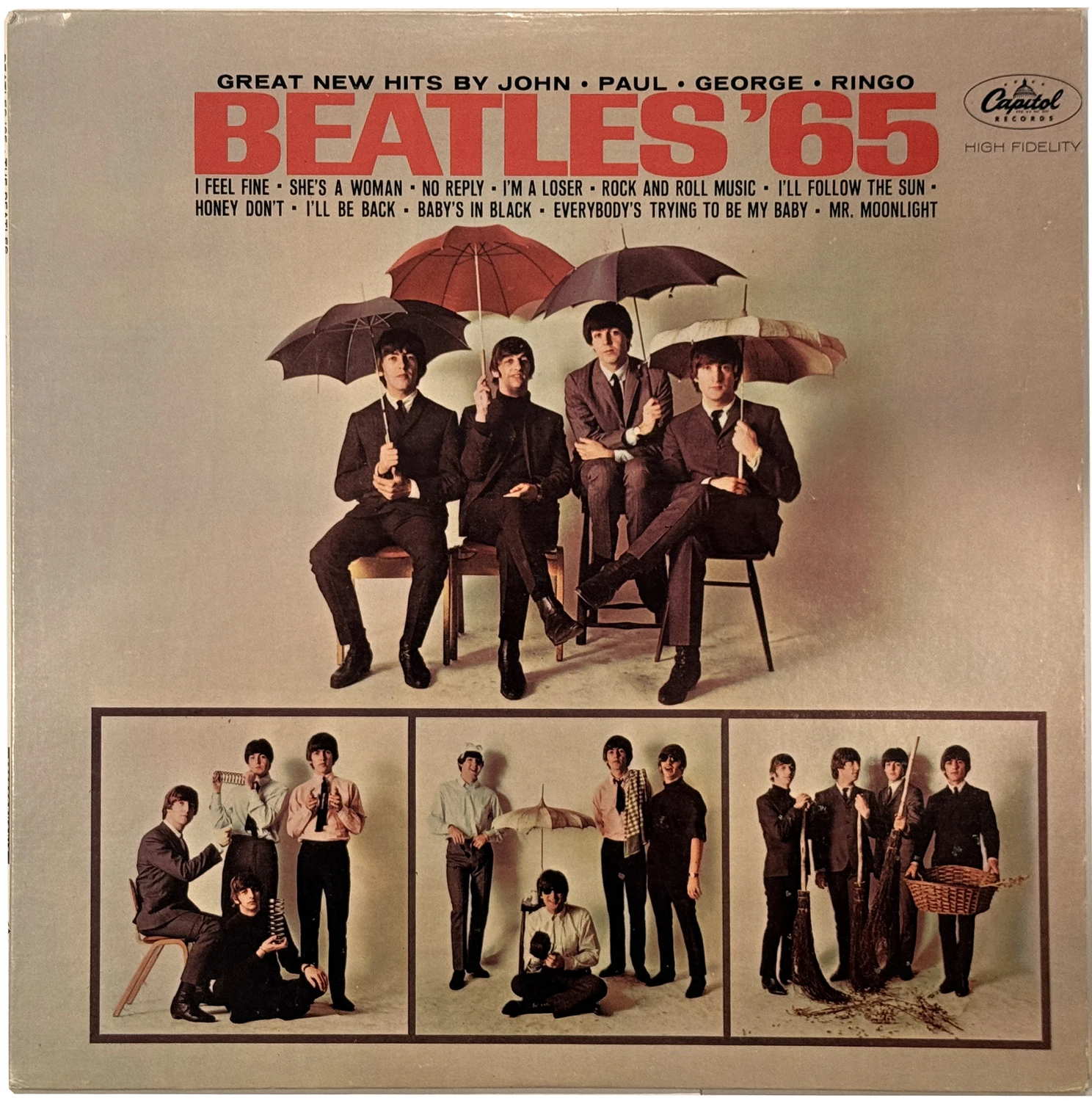
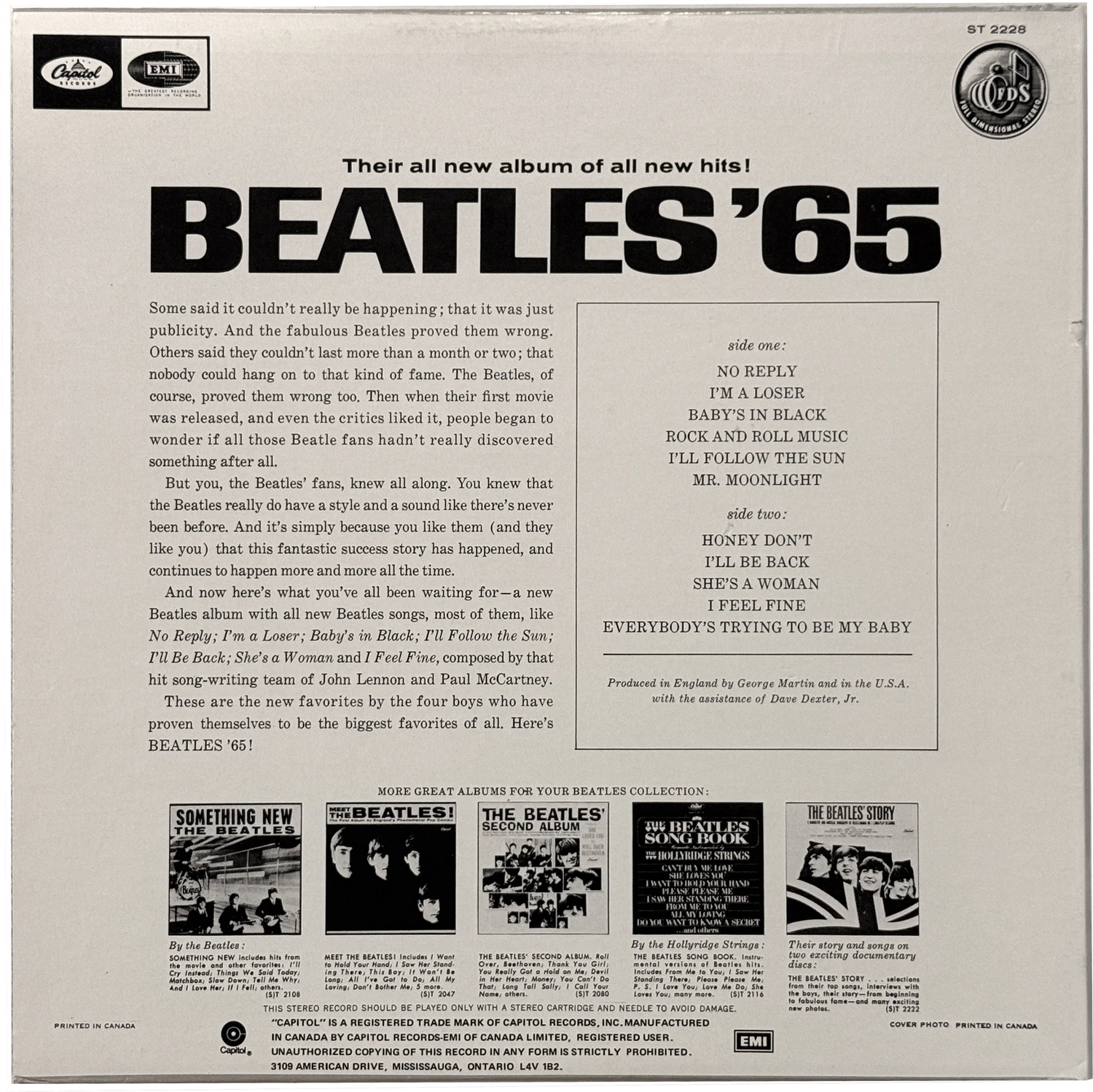
As on LP.2228.7.1, the jacket uses the wraparound construction: front and back slicks are no longer separate, but printed as one large slick folded over the spine of the jacket, like a book.

This construction was introduced by Modern Album (the company that assembled Capitol's jackets) to compete with Shorewood's posterboard covers. Even though they are unmarked, these wraparound slicks were printed by Modern Graphics (see the Printers page for details).
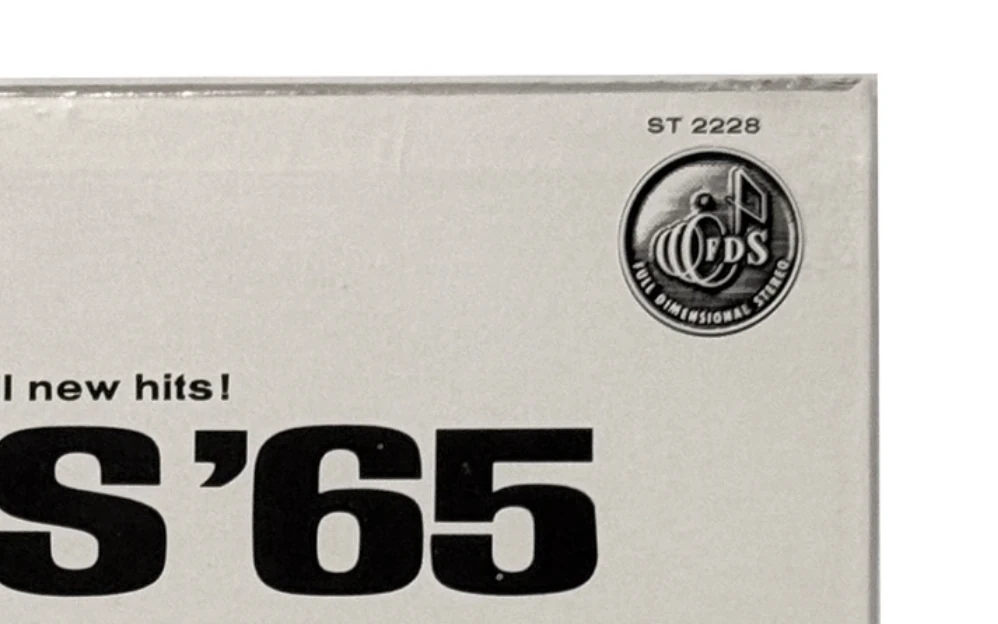
On an assembled cover, the easiest way to spot a wraparound slick is the top right corner of the front cover, where the paper ends in a small cut angled at 45 degrees.
Packaging
This edition was shipped in tight shrink wrap, with or without a plain paper LP inner sleeve. These Capitol sleeves are square and have a slight curve at the top.
