← Something New Variations List
Something New
The "color J-card" design was unique to Canada.
K7.2108.6.1
Color J-card, 4XT number
1985-1991
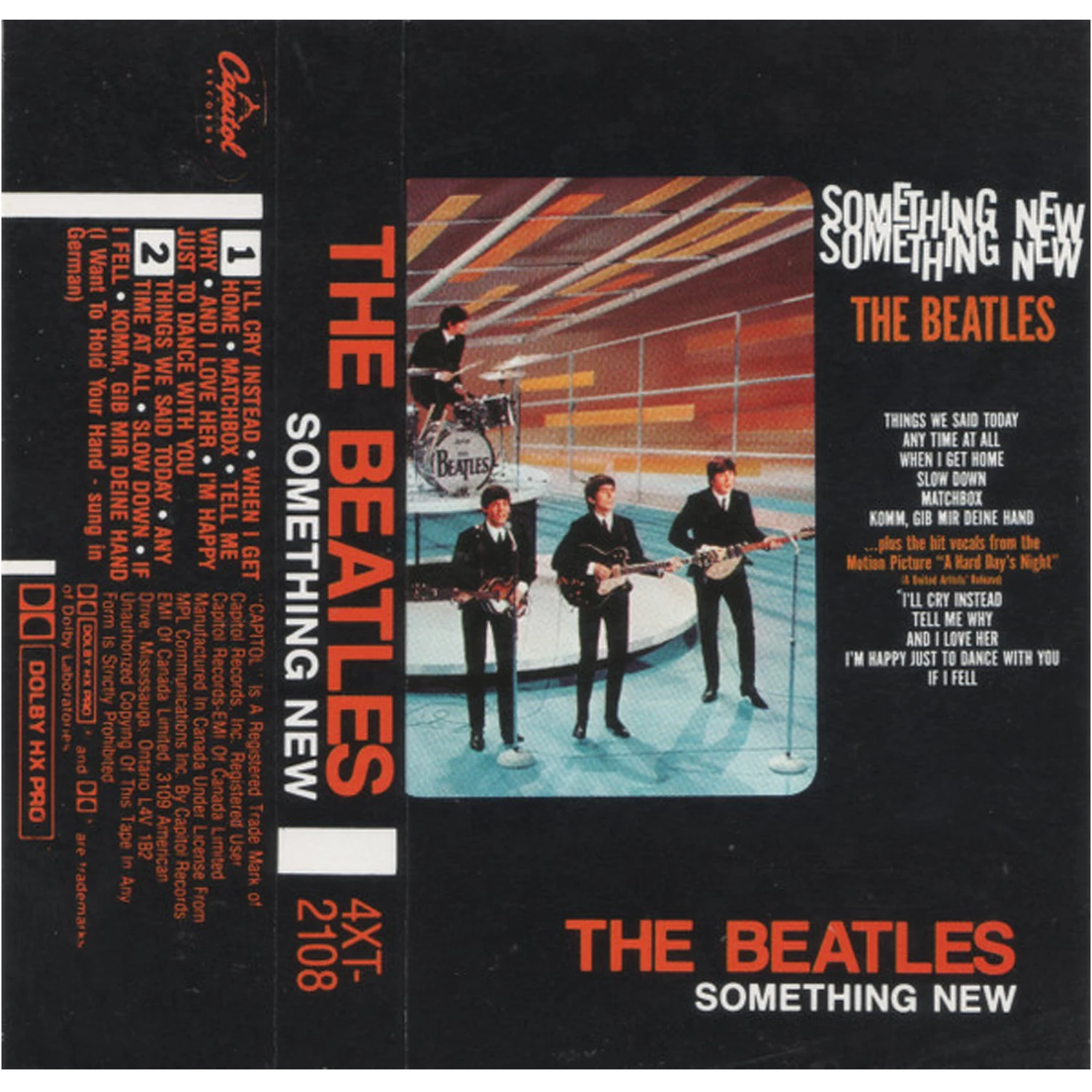
This series of "colored J-card" releases features a design unique to Canadian tapes for Capitol. K7.2108.6.1 was originally pressed on a black shell with silver print. This variation is recognized by its color J-card (each title had a different color) and its 4XT catalogue number. Numbers changed to "C4" in the early 1990s.
Availability
K7.2108.6.1 was introduced in 1985 and remained available until 1991 when the catalogue numbering prefix changed to C4 (see K7.2108.7B.1).
The Something New J-card in this series is black, with the doubled "SOMETHING NEW" logotype and "THE BEATLES" in red beside the live Ed Sullivan Show photograph used on the album cover. The spine reads "THE BEATLES / SOMETHING NEW" with the catalogue number 4XT-2108 below, and the panel carries the Dolby HX PRO logo.
The color J-card Design
While the USA continued using a rather random and custom cassette design, sometimes using old layouts from the 1960s, sometimes playing with the shape of the album cover design to fit the information text, Capitol of Canada proposed a uniform and coherent J-card design. These standardized the placement and size of album covers, titles, band names and legal text, while sporting a vivid color palette unique to every release (the authors named this design the "color J-card").
This made each release unique, while still retaining a clear standardized "capitol branding". These were particularly striking when lined up side by side, creating a rainbow collection of albums where background colors, text and a small separator square varied in flavour, but not in structure, making these Canadian releases very unique and recognizable.

The design remained relatively stable until 2000, with only minor details updated through time (C4 number in 1991 (7A), Bar codes and XDR logo in 1992 (7B/7C), Apple on the J-card in 1994 (7D/7E), Gold color J-card for UK format albums in 1987 (8 and 9A), smaller and longer number in 1995 (9B)). 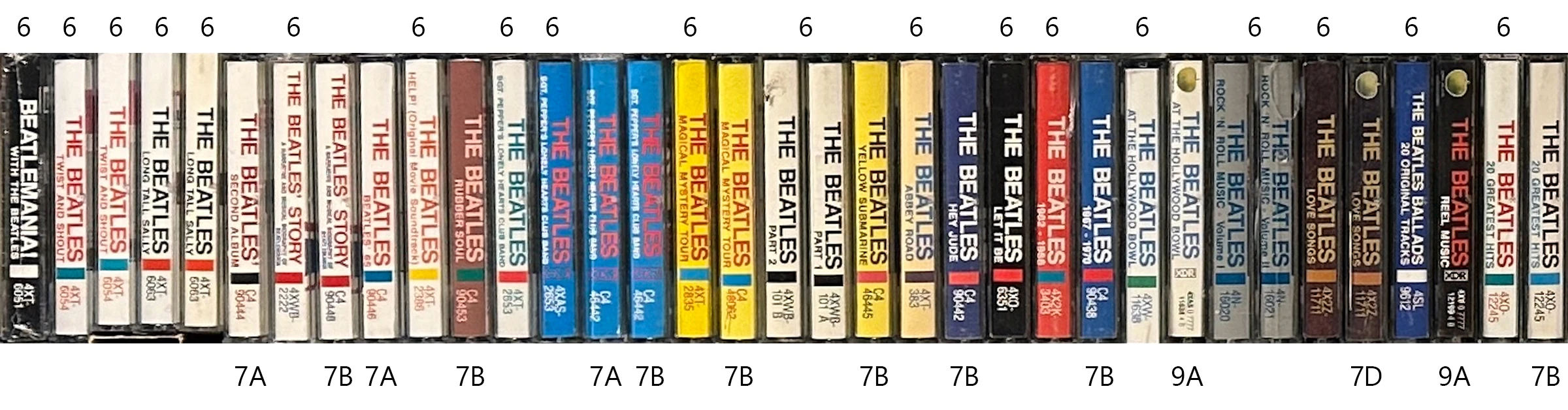
**Note** Only the back catalogue would retain this design after 1993, while new releases (starting with the reissue of the remastered red/blue albums) each featured a unique custom sleeve design after 1993.
Pressing Information
This variation was pressed between 1985 and approximately 1991, and features the same black shell with silver print as the previous black spine variation (K7.2108.3A.3). Early tapes from the 1980s (up until about 1990) used the distinctive "futuristic robot font" (see the big "1" and "2"). These were later changed to a more standard font, around 1990. But all SDR tapes have the "new techno font". Some releases also featured a WHITE shell, but these were randomly found between 1985 and 1994.
No photograph of the shell of this particular copy has been documented yet.
Different types of shells were often used simultaneously and seemingly, also interchangeably. There is no clear timeline based on the types of shells that were used. To further deepen the confusion, between 1982 and 1999, catalogue numbers sometimes randomly went back and forth between "4XT" and "4T" prefixes. All these variations can be found under different combinations, sometimes even having a 4T tape in a 4XT J-card, or a 4XT tape in a 4T J-card (verified examples from sealed tapes opened by the authors have been documented).
Packaging
Tapes were sold in a black back jewel case, and sealed in either a firm wrap that was folded shut, or a regular heat-tightened shrink wrap.
Both types of wrapper have been verified to be used randomly between 1982 and 1995.